





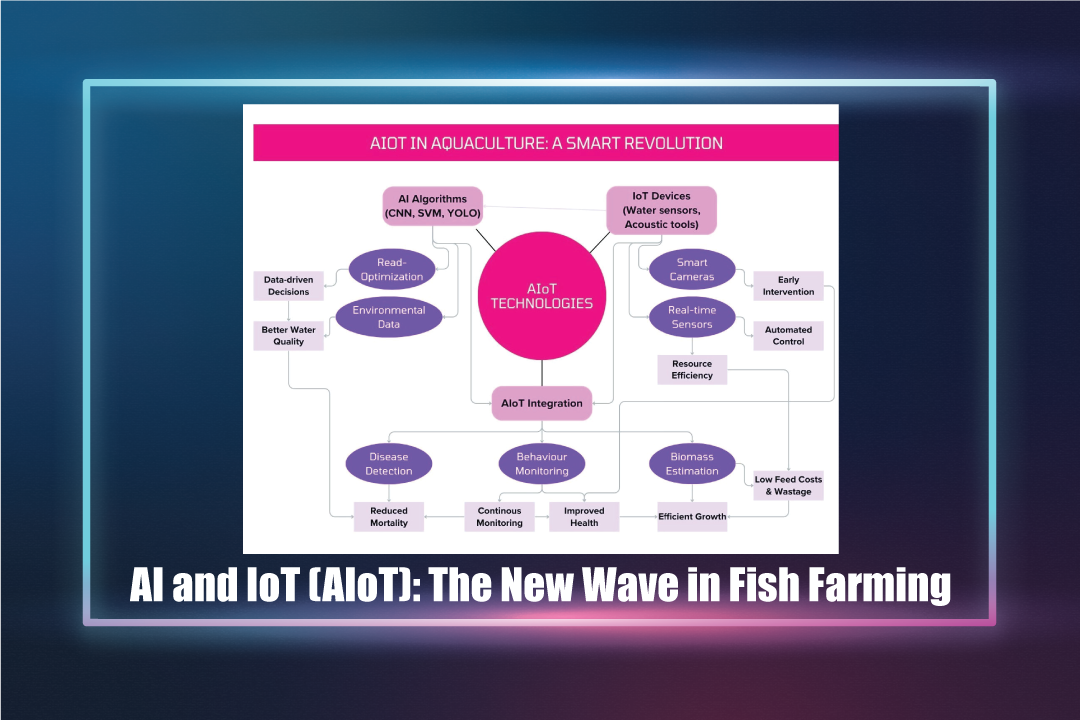
| Aquaculture, once reliant on manual labour and traditional techniques, is undergoing a digital revolution. The emergence of artificial intelligence and the Internet of Things (AloT) is reshaping fish farming into a smart, automated and sustainable sector. While conventional practices have long supported aquaculture’s expansion, AloT represents a shift towards intel-ligent, data-driven farm management.
Artificial intelligence now plays multiple roles across the production cycle, from hatchery management and feeding optimisation to disease diagnosis and harvest planning. By processing large data sets from sensors and imaging tools, Al enables real-time analysis of fish behaviour, stress indicators and biometric traits such as length and weight (Barreto et al., 2022; Tonachella et al., 2022). Predictive models extend this capability by identifying patterns that signal disease onset or sub-optimal conditions, helping reduce economic losses and mortality (Gladju et al., 2022). Complementing Al, IoT infrastructure sensors, cameras, cloud platforms and connectivity modules – forms the backbone of real-time data collection from diverse aquatic environments. These tools continuously monitor water parameters such as temperature, salinity, pH and dissolved oxygen, enabling timely intervention and informed decision-making (Bodaragama et al., 2024; Nagothu et al., 2024). As aquaculture faces growing chal-lenges such as disease outbreaks, nutrient waste and climate variability, AloT-enabled precision aquaculture offers improved biological monitoring, environmental control and traceability (Antonucci & Costa, 2020). Innovations including digital twins and automated water-quality systems allow farmers to simulate conditions, predict outcomes and optimise operations while minimising ecological impact (Ubina et al., 2023; Singh et al., 2022). In short, integrating AloT into fish farming is not just an upgrade; it is a reinvention of aquaculture. This new wave supports a future of resilient, efficient and environmentally conscious aquatic food production capable of meeting global demand without compromising sustain-ability. Challenges in traditional fish farming: Fish farming (aquaculture) plays a vital role in meeting rising global demand for seafood and now accounts for more than half of the fish consumed worldwide. Despite this importance, traditional methods face several challenges:
What are Al and loT?: Artificial intelligence (Al) refers to machines and software that perform tasks requiring human intelligence, such as learning from data, recognising patterns and making decisions. The internet of things (IoT) is a network of physical devices such as sensors and cameras connected via the internet to collect and share real-time data. Overview of studies exploring Al in aquaculture: Numerous studies highlight the trans-formative impact of artificial intelligence (Al) in aquaculture, with applications across the production cycle. Rastergari et al. (2023) examined internet-of-things (IoT) systems for maintaining water quality and monitoring environmental parameters, emphasising the role of smart technologies in farm management. In disease detection, Darapaneni et al. (2022) demonstrated periodic optical monitoring to identify early signs of disease, enabling timely intervention. For intelligent feeding, Chen et al. (2022) used real-time sensor data to estimate shrimp biomass and determine precise feed requirements, while Wu et al. (2022) reported that intelligent feeding equipment can reduce labour, lower risk and improve overall efficiency. In deep-learning applications, Chen et al. (2022) applied an InceptionV3 pre-trained model that achieved 98.94% accuracy in classifying abnormal appearances in groupers, showing clear potential for health monitoring. Mustapha et al. (2021) further underscored Al’s utility in traceability, feeding, disease management, growth forecasting, environmental observation and market analytics, affirming its role in improving productivity and sustainability. AloT applications in aquaculture: Combining the internet of things (IoT) with Al is reshaping aquaculture by introducing more intelligent, efficient and sustainable practices. Enumeration of aquatic organisms: Accurate counting is essential for stock management, health monitoring and feed optimisation. Traditional methods are manual, invasive and error-prone, especially in high-density systems. Advances in Al, computer vision and sensors now support automated, accurate counting across species including fish, shrimp and sea cucumbers. For example, Hu et al. (2023) introduced ShrimpCountNet, a deep-learning density-estimation model that reached 98.72% accuracy when counting shrimp larvae. Pai et al. (2022) combined the YOLOV5 algorithm with optical-flow analysis to detect and count fish while tracking movement patterns as stress indica-tors. Sthapit et al. (2019) applied acoustic signal-processing to estimate fish populations within nets, achieving <10% error. Estimation of fish biomass: Accurate estimation of fish biomass is vital for optimising aquaculture operations, enabling precise assessment of health, growth rates and population density. Reliable biomass data supports efficient feeding strategies, minimises waste accumulation and enhances sustainability. Recent advances in machine learning, computer vision, sonar and smart sensing have enabled non-invasive, real-time biomass estimation, addressing the limitations of manual methods and stress-related inaccuracies. For instance, Zhang et al. (2024) implemented a customised deep-learning model (DL-YOLO) integrated with stereo vision for real-time fish detection, achieving a mean relative error of 2.87% and an R² of 0.98 when estimating fish length, height and weight. Similarly, Rossi et al. (2021) introduced a Bluetooth-enabled dynamic scale capable of measuring juvenile seabream biomass with a mean relative error below 1.4%. In addition, sonar combined with machine-learning models such as VGG networks has been used to estimate biomass in high-density tanks under variable water conditions, demonstrating the potential of AloT systems for precision aquaculture. Intelligent feeding technologies: Smart feeding systems are a major advance in aquaculture, offering automated solutions that monitor feeding behaviour and environmental conditions to deliver precise amounts of feed at optimal times (Huang et al., 2025). The aim is to improve feed efficiency, reduce waste and support sustain-able growth. Current research provides a strong foundation for systems that use several approaches to optimise feeding strategies. For example, Huang et al. (2024) and Li et al. (2022) employed gradient-boosting machines (GBM) and bioenergetic models to refine feeding frequency and nutrient allocation, improving growth performance. Advanced computer-vision techniques, such as R(2 + 1) * D models and enhanced ResNet34 architectures, have been applied for automated detection of feeding behaviour and real-time feed identification (Cao et al., 2024; Atoum et al., 2015). Acoustic monitoring has also been used to correlate sound intensity with hunger levels, with models like the Audio Spectrum Swin Transformer (ASST) enabling accurate classification of feeding intensity (Wei et al., 2020; Zeng et al., 2020). Al-driven water-quality management: Maintaining optimal water quality is essential for sustainable, productive aquaculture, as the health, growth and welfare of aquatic species are closely tied to environmental conditions. Fluctuations in key parameters, dissolved oxygen (DO), pH, temperature and ammonia, can harm fish physiology, reduce growth and increase vulnerability to disease. Integrating loT sensors with Al-based predictive analytics is increasingly important, enabling continuous, real-time monitoring and timely interventions to mitigate adverse conditions (Sun et al., 2020; Collos et al., 2014). For example, Sun et al. (2020) reported that deep-learning techniques, including convolutional neural networks (CNNs) and recurrent neural networks (RNNs), can forecast critical events such as oxygen depletion and water-quality deterioration. Similarly, Singh et al. (2022) presented a sustainable loT solution for freshwater aquaculture that uses Al-driven monitoring to predict algal blooms and maintain environmental stability. Tracking fish movement: Accurate monitoring of fish behaviour, health, feeding patterns, breeding activity and population dynamics is essen-tial in both controlled and natural environments. Schraml et al. (2021) showed that iris-pattern recognition can serve as a biometric tool for short-term identification of Atlantic salmon, achieving over 95% accuracy. Liu et al. (2019) developed a 3D video-tracking system to monitor fish behaviour in tanks, reporting precision above 95%. Williamson et al. (2017) used a modified nearest-neighbour algorithm to track fish and seabird activity around tidal turbines, even under turbulent conditions. To address issues with moving cameras, Chuang et al. (2017) proposed the deformable multiple-kernel (DMK) tracking algorithm, which maintained high accuracy despite variable camera motion. Monitoring fish behaviour: Monitoring behaviour is crucial for ensuring health, welfare and growth in aquaculture systems. Behavioural changes often signal stress, disease, feeding status or unfavourable environmental conditions, allowing earlier, better-informed decisions. Hu et al. (2024) introduced a deep-learning system using a ResNeXt 3 x 1D convolutional network, achieving 95.3% accuracy in detecting abnormal behaviours. Hassan et al. (2020) developed a Doppler-based acoustic telemetry method to estimate swimming speed in marine cages, reporting a root-mean-square error of 7.85 cm/s across a range of biologically relevant velocities. Use of Al technologies for the diagnosis of aquatic animal diseases: A key application of artificial intelligence (AI) in aquaculture is early identification and control of disease, which is essential for maintaining health and welfare (Rather et al., 2024). Al offers rapid, accurate and non-invasive diagnostic capabili-ties that can greatly improve detection and management. Using machine-learning and deep-learning techniques, Al can analyse images to identify physical symptoms, such as lesions, discolouration or abnormal growths, in fish and shrimp. Al-powered systems can also monitor behavioural changes, including erratic swimming or reduced feeding, by analysing video or sensor data. Predictive models built from historical disease records, environmental conditions and water-quality parameters can forecast potential outbreaks. These tools support early diagnosis and timely intervention, help reduce antibiotic use and improve farm productivity through decision-support systems tailored to local conditions. Multiple Al techniques have been applied effectively in disease detection. Li et al. (2023) used a deep-learning algorithm (YOLOv4, implemented in Python) to detect fish parasites, Ichthyophthirius multifiliis, Gyrodactylus kobayashii and Argulus japonicus, achieving 95.41% detection accuracy. Ahmed et al. (2022) applied a support vector machine (SVM) to distinguish infected from healthy fish, reporting 91.42% accuracy without augmentation and 94.12% with augmenta-tion. Hassan et al. (2022) used a convolutional neural network (CNN) to detect red-spot and white-spot diseases, recording 94.44% accuracy for red spot and 91.67% for white spot. Together, these studies illustrate Al’s growing role in improving the accuracy and efficiency of disease detection in aquaculture. Al algorithms can also support better decisions by analysing complex data sets. By leveraging data from sensors, satellite observations and historical records, Al can optimise decision-making to support fish health and growth (Gladju et al., 2022). Furthermore, Al can flag early signs of disease by integrating behavioural patterns, physiological indicators and environmental factors. These technologies also enable precision-aquaculture practices, optimising production processes through real-time data analysis (Fini et al., 2025). Benefits of smart aquaculture: Integrating Al and lot offers several benefits:
The future of Al and loT in aquaculture: As technology advances, opportunities for smart aquaculture are expanding:
With more sophisticated machine-learning models, predictive analytics will play a larger role in planning production cycles, managing resources and responding to climate change. Conclusion: The integration of artificial intelligence and the internet of things (AloT) is ushering in a new era of innovation and efficiency in aquaculture. AloT is addressing long-standing challenges such as water-quality management, disease detection and feed optimisation by enabling real-time monitoring, predictive decision-making and automation across production stages. Smart technologies show strong potential to improve fish health, reduce environmental impact and lift overall productivity. As digital tools become more accessible and capable, the sector is moving from traditional, labour-intensive operations to intelligent, data-driven systems. Barriers to widespread adoption remain cost, infrastructure and training, but the future of aquaculture clearly lies in precision, sustainability and technological integration. Continued research, collabora-tion and innovation will be essential to unlock the full potential of AloT and build a more resilient, responsible aquaculture industry. References
Writers: Arun Konduri¹, Raveendar Banothu¹, Shyam Prasad. M¹”, Potluri Sai Kishore², Kalithkar Bheemeswararao³
Source: Aquaculture Asia Magazine. |