







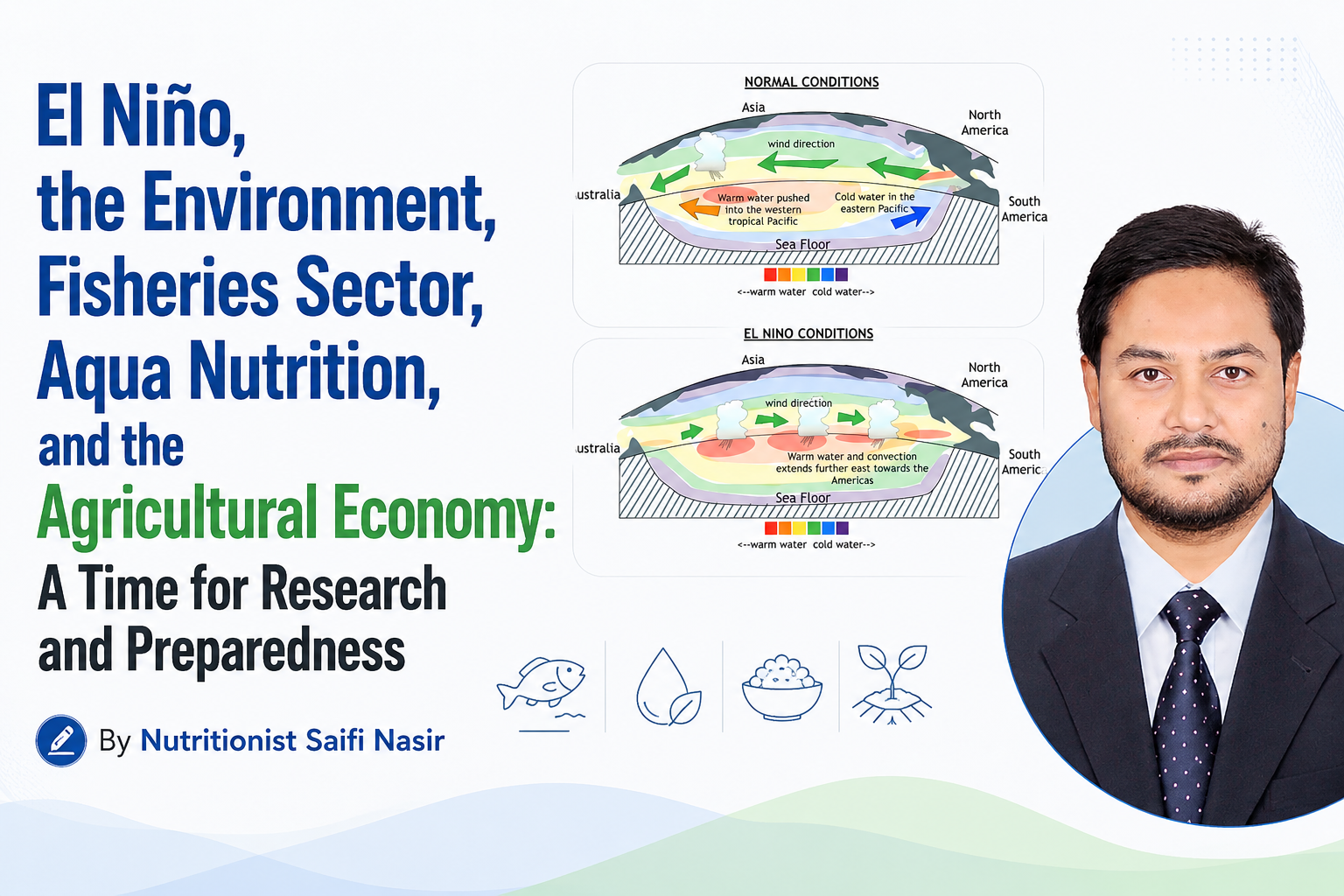
| El Niño is a periodic warming of sea surface temperatures in the tropical Pacific Ocean that has far-reaching effects on global climate patterns and marine ecosystems.
Fundamentally, El Niño is a naturally occurring climate phenomenon resulting from interactions between the ocean and the atmosphere. More broadly, it refers to an abnormal rise in sea surface temperatures across the tropical Pacific Ocean, accompanied by significant changes in atmospheric circulation patterns. Occurring approximately every 2–7 years, El Niño often triggers extreme weather events worldwide, including droughts, floods, and unusually high temperatures. It represents the warm phase of a larger climate cycle. Drawing on findings from multiple scientific studies, Nutritionist Saifi Nasir notes that the European Centre for Medium-Range Weather Forecasts (ECMWF) has indicated a high probability of an “enhanced” El Niño event developing, which could influence regional and global weather patterns during the summer or autumn of 2026. This assessment further strengthens forecasts that were first highlighted in 2025 regarding the potential emergence of a Super El Niño event. During a typical El Niño episode, the redistribution of warm waters across the equatorial Pacific affects weather conditions around the globe, leading to droughts, floods, elevated temperatures, and accelerated polar ice melt. Super El Niño events, which are relatively rare and tend to occur every 10–15 years, can produce more intense, long-lasting, and widespread impacts. In such cases, sea surface temperatures in key regions may rise by more than 2°C above average, triggering powerful atmospheric responses that generally peak between December and January. As a result, regions such as parts of the western United States, Africa, Europe, and India may experience significantly warmer-than-normal conditions. At the same time, tropical areas including the Caribbean and Indonesia face heightened risks of severe drought and extreme heat. According to weather outlooks published by the Old Farmer’s Almanac, much of North America is expected to experience a warmer-than-average summer in 2026. Both the United States and Canada are forecast to record above-normal temperatures, while rainfall patterns are expected to vary considerably by region. The latest CCSR/IRI ENSO plume forecasts suggest a 70% probability of El Niño conditions developing during April–June 2026, compared with a 30% probability of neutral conditions. Furthermore, there is an estimated 88–94% likelihood that El Niño conditions could dominate throughout the remainder of 2026. Additional research indicates approximately a 30% chance that 2026 could become the second year in which global temperatures exceed 1.5°C above pre-industrial levels. While the development of a strong or Super El Niño during the latter half of 2026 may contribute to rising temperatures, its most significant impacts are likely to be felt in 2027. Implications for the Fisheries Sector: Nutritionist Saifi Nasir warns that the fisheries sector is directly and adversely affected by El Niño. Key consequences include:
Potential Impacts on Bangladesh: Analyzing the potential effects of El Niño on Bangladesh, Saifi Nasir explains that the phenomenon, driven by abnormal warming in the Pacific Ocean, often contributes to severe heatwaves, drought conditions, and substantial agricultural losses in the country. During El Niño years, Bangladesh generally experiences a weaker monsoon, resulting in reduced rainfall and a higher likelihood of drought. Looking ahead, Bangladesh may face several challenges associated with El Niño, including:
Global Climate Concerns: Referring to findings published in various scientific journals and citing Professor Paul Roundy of the State University of New York at Albany, Saifi Nasir notes that atmospheric scientists are increasingly recognizing the possibility of one of the strongest El Niño events in recent decades. A Super El Niño could push global temperatures to record-breaking levels, particularly in 2027, while simultaneously altering weather patterns in ways that significantly affect agriculture, livestock production, and fisheries. Current assessments suggest that a potential Super El Niño developing in 2026 could have widespread consequences and persist into 2027. Such an event could even surpass the intensity record set in December 2015, when sea surface temperatures in the central equatorial Pacific Ocean reached approximately 2.8°C above average. Across Southeast Asia, including Bangladesh, as well as parts of central and northern India, increased drought risk and weaker monsoon activity could adversely affect agricultural, livestock, and fisheries production. Meanwhile, the western United States may experience higher-than-average summer temperatures and humidity levels, accompanied by unusually heavy rainfall and an extended storm season. Conclusion: In conclusion, Saifi Nasir emphasizes that major El Niño assessments and research cycles often highlight significant developments every 10–15 years. Following the major event of 2015, indications suggest that a new phase of El Niño may begin strengthening between June and September 2026, with its effects becoming more pronounced throughout 2027. If current projections materialize, Bangladesh and many other parts of the world could experience substantial impacts on agriculture, livestock, and fisheries production. Rising temperatures, warmer atmospheric conditions, changes in sea levels, prolonged dry weather, drought, reduced agricultural productivity, limited access to safe drinking water, and insufficient rainfall are among the potential consequences associated with a future Super El Niño event. Saifi Nasir stresses that these challenges underscore the urgent need for intensified research, preparedness, and adaptive strategies across environmental, fisheries, aquaculture, and agricultural sectors to mitigate potential economic and food security risks. Writer: Nutritionist Saifi Nasir, Aqua Nutrition & Aquaculture, KGS Group. |