






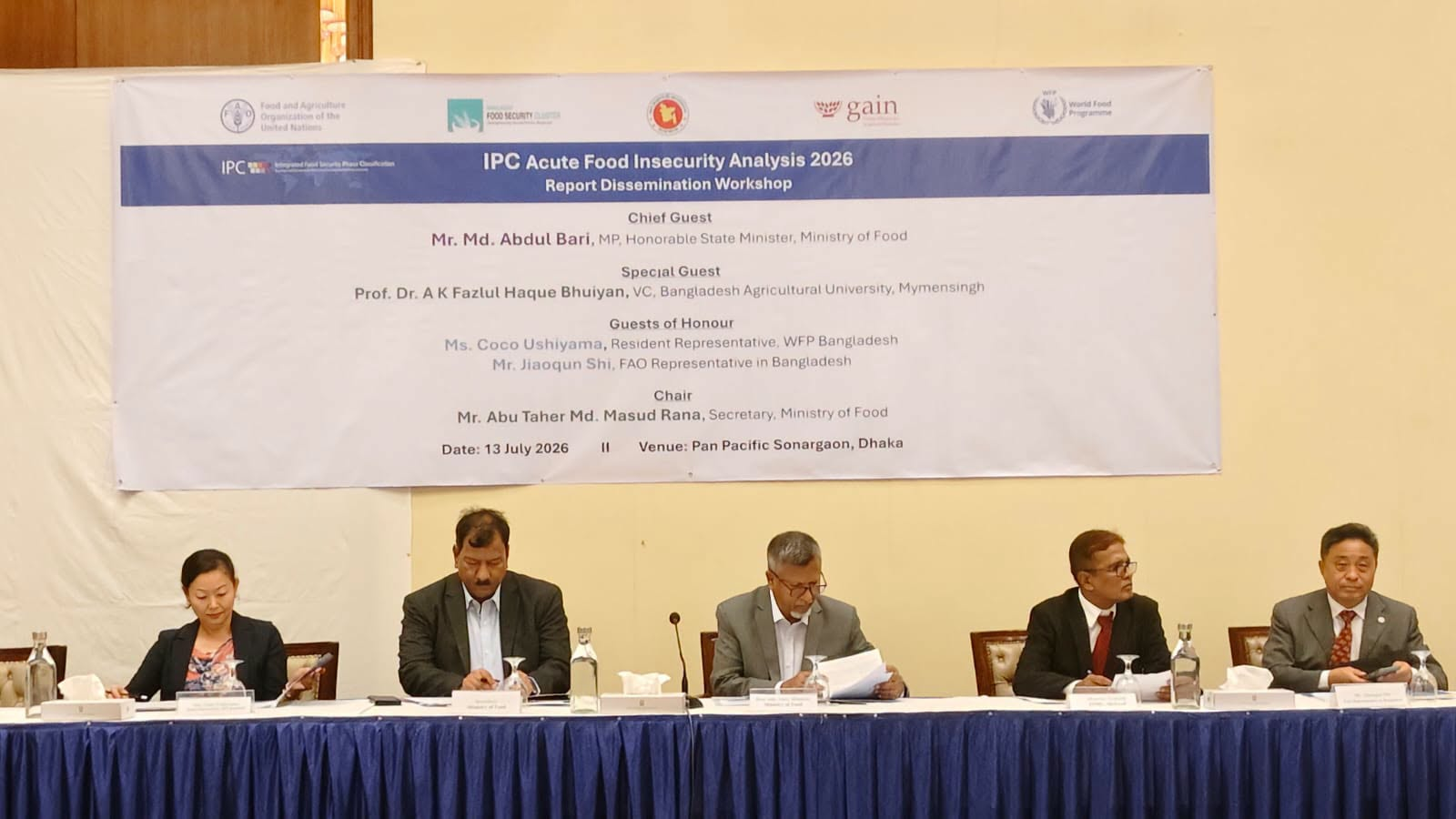
| Dhaka, 13 July 2026: Food security continues to be a pressing challenge in Bangladesh, with millions of people facing acute food insecurity. In response, the Ministry of Food, in collaboration with the Food and Agriculture Organization (FAO), the World Food Programme (WFP), Action Against Hunger, Save the Children, and GAIN, launched the latest IPC Acute Food Insecurity Analysis 2026 at a high-level dissemination workshop held at the Pan Pacific Sonargaon.
The workshop was attended by senior government officials, development partners, humanitarian organizations, and food security experts. The findings of the IPC (Integrated Food Security Phase Classification) analysis reveal that approximately 15.3 million people in Bangladesh are currently experiencing high levels of acute food insecurity. The report further warns that the situation could deteriorate, with the number projected to rise to 18.1 million people by the end of 2026 if adequate interventions are not implemented. The event was inaugurated by Mr. Md. Abdul Bari, MP, Honorable State Minister for Food, while Prof. Dr. A K Fazlul Haque Bhuiyan, Vice Chancellor of Bangladesh Agricultural University attended as Special Guest. Guests of Honour included Ms. Coco Ushiyama, Resident Representative of WFP Bangladesh, and Mr. Jiaoqiun Shi, FAO Representative in Bangladesh. The workshop was chaired by Mr. Abu Taher Md. Masud Rana, Secretary of the Ministry of Food. Speakers emphasized that climate change, recurrent natural disasters, inflation, and economic vulnerabilities are among the key factors contributing to food insecurity across the country. They stressed the importance of strengthening social protection programmes, enhancing agricultural productivity, improving market management, and ensuring coordinated humanitarian assistance for vulnerable communities. Participants also highlighted the need for stronger collaboration between government institutions, development agencies, and humanitarian partners to address the growing food security challenge effectively. The workshop served as a platform to review evidence from the latest IPC analysis and identify priority actions for safeguarding food security and nutrition for all. According to experts, timely policy measures and coordinated interventions will be crucial in preventing further deterioration of the food security situation and protecting millions of at-risk households across Bangladesh. |