






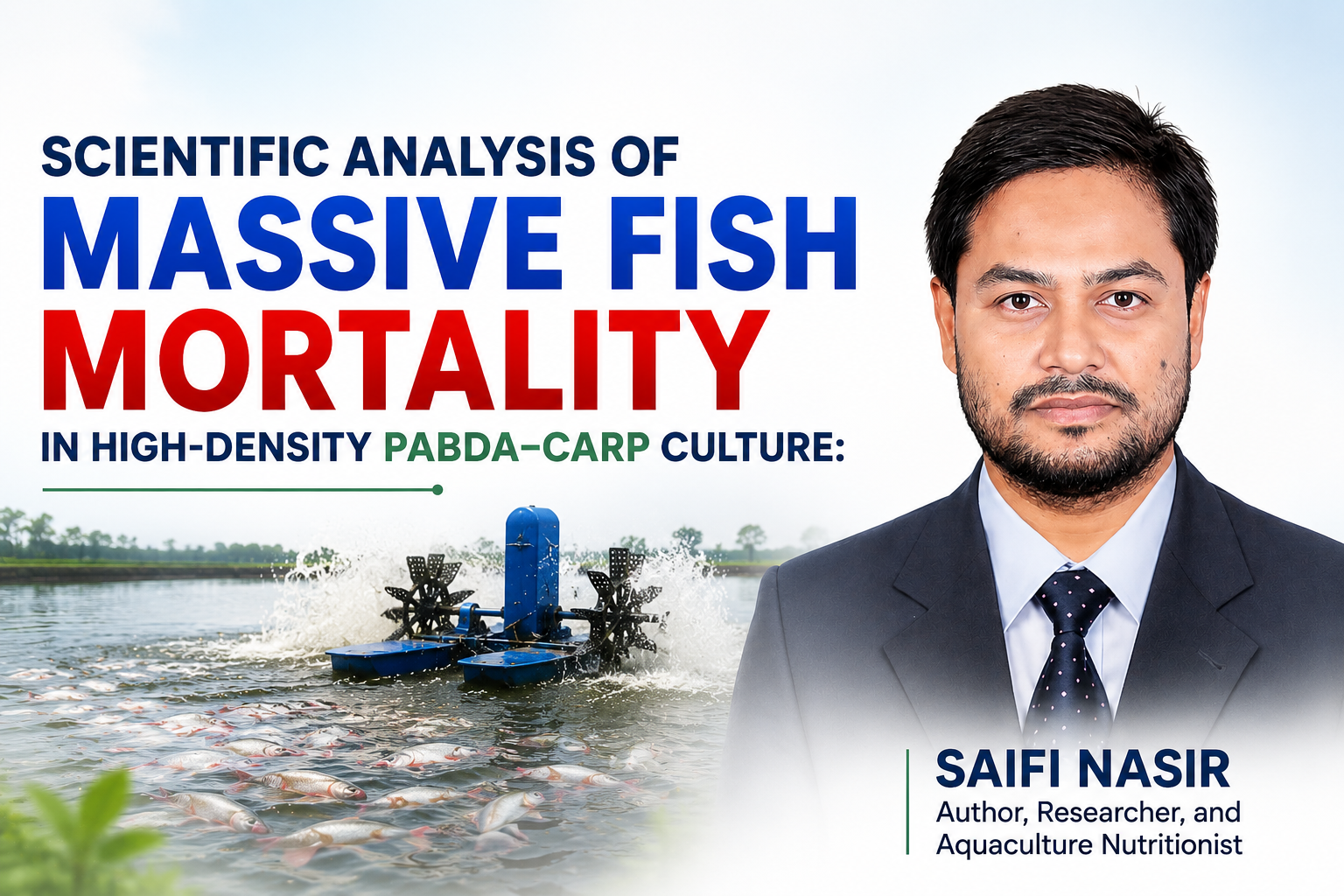
| Saifi Nasir Author, Researcher, and Aquaculture Nutritionist Uttara, Dhaka, Bangladesh Mobile: +8801762019343 Email: saifinasir9343@gmail.com 1. Executive Summary According to the information available, it would not be scientifically safe to identify either a load-shedding-related accident or merely a failure of the farmer’s management as the sole cause of the incident. Rather, the possible causal chain may be: Extremely high stocking density → Higher feed input → More fecal waste and uneaten feed → Bottom organic loading → Microbial decomposition → Increased oxygen demand → Decrease in DO → Impaired nitrification → Increase in NH₃/NH₄⁺ and other metabolites → Anaerobic zone → H₂S production → Fish gill stress → Hypoxia/toxic stress → Mass mortality If aeration stopped due to a power outage at night or before dawn, then this could have acted as an acute trigger or precipitating factor for this already-stressed pond system. In other words: load shedding may not have been the sole primary cause; however, a power outage on top of high organic loading and inadequate aeration could have acted as a catastrophic trigger. 2. Mathematical Analysis of Stocking According to the information: Farm = 200 bighas Pabda stocking density 6,000,000 ÷ 6,600 = 909.1 fish/decimal That means approximately 909 Pabda per decimal. If 1 decimal ≈ 40.47 m²: 909 ÷ 40.47 ≈ 22.46 fish/m² That means approximately 22.5 Pabda/m². Published research on Pabda culture in Bangladesh has shown changes in water-quality stress and production performance with increasing stocking density. In one pond-based polyculture study, stocking densities of 500, 600, and 700 Pabda/decimal were compared, and better growth, survival, and production were found at the lowest density. Another study tested 2.0, 2.5, and 3.0 lakh Pabda/ha in semi-intensive pond culture and found a declining trend in production with increasing density. Therefore, it is reasonable to consider 909 Pabda/decimal as a highly management-sensitive density. However, it cannot be called unscientific based only on the stocking number because the initial size of the fish, final biomass, pond depth, aeration capacity, feed input, water exchange, and culture technology need to be known. 3. Most Important Issue: Fish Number, Not Fish Biomass Here, one scientific issue is extremely important. Hearing 6 million fish may make the density appear very high. However, fish number alone is not sufficient to determine ecological loading. It is also necessary to know: √ What is the average body weight of the Pabda? Example: If 6 million Pabda have an average weight of 10 g: 6,000,000 × 0.01 kg = 60,000 kg biomass That means 60 metric tonnes of Pabda biomass. And if the average weight is 20 g: 120 metric tonnes biomass. Therefore, without knowing the final biomass, it is not possible to accurately calculate oxygen demand and organic loading. 4. Possible and Scientifically Research-Based Causes 4.1 Organic Loading In intensive aquaculture, when stocking density and supplemental feed increase, bottom sludge or organic matter can accumulate due to uneaten feed and fish feces. A study on intensive aquaculture in Bangladesh found that high stocking density and supplemental feeding cause unused feed and faeces to accumulate at the pond bottom, and accumulated sludge can reduce dissolved oxygen and release harmful substances/gases. Therefore, the scientific basis of this part is sufficiently strong: High stocking → High feed → High fecal waste → High organic matter → High microbial oxygen demand 4.2 Bottom Sludge When organic matter accumulates at the bottom of the pond, bacteria continue to break it down through decomposition. This decomposition requires a large amount of oxygen. As a result: Organic matter ↑ Especially when anaerobic conditions develop within a deep sludge layer, hydrogen sulfide (H₂S) can be produced. FAO’s aquaculture guidance also states that organic-rich and anaerobic pond mud can be an important source of H₂S, and H₂S is highly toxic to fish. 4.3 Nitrate ≠ Toxic Gas “toxic gases such as ammonia, nitrate, and hydrogen sulfide” needs to be scientifically corrected. Ammonia Ammonia exists in water mainly as: NH₃ + NH₄⁺ Among these, the unionized NH₃ fraction is more toxic to fish. Nitrate NO₃⁻ nitrate is not a gas. Nitrate exists in water as a dissolved nitrogen compound. Scientifically, it can be stated as “toxic metabolites/compounds such as ammonia, nitrite, nitrate, and hydrogen sulfide.” 4.4 Ammonia Problem When DO Is Low Oxygen is required for nitrification in the pond ecosystem. Generally: NH₃/NH₄⁺ → NO₂⁻ → NO₃⁻ This microbial oxidation process is oxygen-dependent. When DO becomes very low, nitrification efficiency may decrease and ammonia/nitrite management may become difficult. FAO guidance also mentions that dissolved oxygen deficiency can disrupt ammonia and hydrogen sulfide conversion processes and can negatively affect fish health. 4.5 Hydrogen Sulfide When organic-rich bottom conditions and anaerobic conditions exist, H₂S can be produced by sulfate-reducing bacteria. It is highly toxic to fish. FAO guidance mentions that there is a relationship between bottom disturbance, pressure/weather changes, and H₂S release. However, an important point here is that H₂S poisoning cannot be confirmed merely by looking at pictures of dead fish. To confirm it, the following are required: √ Water H₂S 4.6 Temperature As water temperature increases, the metabolic rate and oxygen demand of fish may increase. At the same time, changes in temperature and pH alter the toxic unionized NH₃ fraction of total ammonia. That is: Temperature ↑ + pH ↑ → NH₃ fraction ↑ Therefore, hot weather + high biomass + high feeding + low aeration is a dangerous combination. Research on Pabda in Bangladesh has also found a relationship between stocking density and changes in DO and ammonia-N. 4.7 Sudden Rain or Heavy Rain Sudden heavy rain can rapidly change surface water temperature, cause pond-water mixing, break stratification, and bring reduced water from the bottom upward. Phytoplankton dynamics may change, and the possibility of H₂S release may increase with changes in atmospheric pressure/weather. However, “whenever it rains, all toxic gases from the bottom rise into the water and kill the fish” is a simplified explanation that is pond-specific. 5. Corrections and Scientific Solutions 5.1 Bottom Cleaning Every 10 Days and Water Exchange Every 15 Days — This Also Needs Correction This is not a universal rule because bottom-cleaning frequency depends on: √ Stocking biomass Similarly, the interval for water exchange should not be fixed at 15 days; rather, it should be water-quality-parameter-driven management. That means the timing of water replacement should be determined by water-quality parameters, not by the calendar. 5.2 An Important Issue from the Perspective of Fish Nutrition In this type of intensive culture, feed management is extremely important. Excess feed means not only fish growth. A portion of the nitrogen and phosphorus in feed goes into fish biomass, while the remainder enters the pond ecosystem as feces + dissolved metabolites + uneaten feed. Therefore: Poor FCR → More feed input → More waste → Higher oxygen demand → Greater water-quality risk Thus, in high-density fish farming, feed formulation + digestibility + pellet water stability + feeding management + FCR are directly related to pond mortality risk. 6. Warning: For high-density farmers, this incident should be viewed as an important warning for Bangladesh’s intensive aquaculture sector rather than as an opportunity to blame any individual or group. High-density farming does not mean only more fish—it is a complete life-support system. As the number of fish increases: Biomass ↑ → Feed ↑ → Oxygen demand ↑ → Waste ↑ → Aeration requirement ↑ → Emergency preparedness requirement ↑ Therefore, high-density ponds must have: √ Continuous/regular DO monitoring, 7. Forensic & Laboratory Analysis If the incident was primarily an acute oxygen crash, fish may generally rise to the surface and gasp, gather near inlets/aerators, mortality may be higher at dawn, and extremely low DO may be found. If H₂S toxicity is present, rotten-egg odor, dark/black anaerobic sediment, gill damage, and sudden mortality may be observed along with bottom disturbance. After such mass mortality, a Forensic Aquaculture Investigation should be conducted. For example: √ Water
√ Sediment
√ Fish
√ Farm records
8. My Scientific Verdict Based on the current information, I would classify the incident as follows: √ Primary risk, Therefore, the conclusion that only the electricity office is responsible for this accident is not scientifically proven. Likewise, it cannot be said that load shedding had no role. The most likely scientific explanation is that a high-risk intensive aquaculture system had remained for a prolonged period under a low oxygen margin and high organic loading; on top of this, an aeration interruption or power failure could have acted as an acute environmental trigger and caused mass mortality. 9. Final Research-Based Conclusion The most scientific answer to the question “Who is responsible?” in this incident is that it was probably not a single-cause accident but rather a Multifactorial Aquaculture Failure (MAF). Extremely high stocking, high biomass, feed-derived organic loading, bottom sludge, inadequate aeration, and possible water-quality deterioration were underlying risk factors. And if a power outage occurred, it was a possible acute trigger. Therefore, instead of holding any party solely responsible without evidence, final causation should be determined only after analyzing DO, TAN/NH₃, NO₂, H₂S, sediment condition, biomass, aeration capacity, and the power-outage timeline. Research on Pabda culture in Bangladesh also shows that increasing stocking density can create pressure on growth, survival, and water-quality parameters; particularly in high-density treatments, DO may decrease and ammonia-related stress may increase. In my assessment, load shedding may have been the final blow that triggered the accident; however, a high-density aquaculture system must be managed in such a way that even under sudden situations such as a power outage, a critical oxygen level for the fish does not develop. This is far more research-based, neutral, and professional than either the position of “blaming the farmer” or “blaming the electricity office.” 10. Most Important Question 10.1 Is Load Shedding Responsible? It is possible. If the oxygen balance of the pond is already in a marginal condition, DO can rapidly reach a critical level after the aerators stop. The risk is particularly high during the late part of the night/before dawn because: During the day: Phytoplankton → Photosynthesis → O₂ production But at night: Photosynthesis = 0, and fish + bacteria + organic matter all consume oxygen. Therefore, toward dawn, DO is generally in its most vulnerable condition. Mass Mortality sequence: High stocking density This scenario is scientifically quite plausible. It is also wrong to hold load shedding alone responsible. 10.2 Is Saying “Farmer’s Mistake” Scientific? Saying “It is foolish to put the blame for one’s own mistake on the electricity office” would not constitute the basis of a research study. Because there is insufficient information about whether a power outage actually occurred, how long it lasted, at what time it occurred, and how many aerators were shut down during that period. Rather, the scientific wording would be that the power outage may be considered a potential acute triggering factor; however, without information on long-term pond management, stocking biomass, organic loading, aeration capacity, and emergency preparedness, it is not scientifically acceptable to assign sole responsibility for the accident to either the electricity-supplying institution or the farmer. |